


China’s Out-In-The-Open Gems: Zhangjiajie (Avatar Mountains) and Guilin

China’s natural landscape is often overshadowed by its rich cultural heritage and might not top a tourist’s must-see list. Not for lack of beauty, mind you, but more because of its sheer size, diversity, and the challenge of navigating it all as a non-Chinese speaker. Simply put, it’s hard to know where to start or how to go about it. Since we’re always on the lookout for outdoor adventures, I started asking around. Turned out the answer was unanimous among expats and Chinese friends alike: you simply can’t leave China without seeing Zhangjiajie (more specifically the Avatar Mountains) and Guilin.
I finally ticked them off my list this spring (2025), joining longtime friends who flew in from Europe, braving their own travel nerves for the adventure. We opted for a private tour, which gave us the perfect balance: expert guidance, seamless logistics, access to off-the-beaten-path spots, and enough freedom to do our own exploring. Their itinerary had also enriched my wish list with a new objective, the Longji Rice Terraces, an experience I will treasure forever.
Zhangjiajie (Avatar Mountains)
The “Avatar Mountains” owe their nickname to James Cameron’s film, which drew inspiration from their otherworldly look. Formally known as the Zhangjiajie Sandstone Peak Forest National Geopark, they stretch across 3,600 km² in Hunan province and today hold a UNESCO Global Geopark status. Ironically, their fate once teetered on the edge of becoming raw material for glass manufacturing. In a time when outdoor tourism was barely a concept in China, financial hardship nearly led the province to sell the site to private enterprise. Fortunately, one artist who recognised the raw beauty of the landscape stepped in. His appreciation turned into a campaign, and against the odds, he succeeded in tipping the balance toward preservation.
Getting close to these natural wonders is more than a walk in the park as the area is vast, layered, and complex. Although well organised, it would have been less relaxing without a guide. Ours smoothed out the cable cars, buses, sightseeing cars, and led us to quieter corners for near-private encounters with the scenery.
We took the cable car up to Tianzi Mountain (天子山). It’s always crowded, but we lucked out with a 15-20 min wait, an absolute breeze compared to the standard two-hour one.
The natural physical erosion of the quartz sandstone mountains has created, over time, a surreal landscape. The pillar-like formations, giant stalagmites covered by a lush vegetation, rise from the bottom of the valley, in places you expect least. Their shapes stir your imagination and make you feel in a fairy tale land. There were no wild or strange creatures that I could spot from a distance, no matter how carefully I was scanning the alien looking landscape. I could then fully understand what the artists that created Avatar’s characters would have felt; what they created fitted right in!
From there, a bus carried us to Yuanjiajie (袁家界) Scenic Area, the park’s crown jewel.
It was here that we got as close as one can

to the park’s most iconic feature: the South Sky Pillar, the real-life inspiration for “Avatar’s” floating Hallelujah Mountain. The movie’s global fame ended up rewriting local geography. Its official name is now the Avatar Hallelujah Mountain, a rebrand that's part easier reference, part free publicity.
We admired from a distance the so-called First Bridge of the World (also known as “First Bridge Under Heaven”).
This natural sandstone arch is what remains after millennia of nature’s chiselling; wind, rain, and sun gradually eroded the mountain until only a narrow bridge was left linking two surviving peaks.

Is it really the first? Maybe, or maybe just the first to be named. Either way, it’s spectacular and well deserving of a top-tier title. Accessible to the public and being a major attraction makes it also very busy. Watching from afar turned out to be the best way to truly appreciate this masterpiece of Mother Nature.
On our way between scenic spots, we stumbled upon an unexpected sight: rice fields perched high up on the mountain. I learned later they are officially called Fields in the Air (空中田园). Sitting at over 1,000 meters above sea level, the terraces were as stunning as they were surprising. They looked very much in use, though we couldn’t understand how, as there were no visible roads or paths leading to them. “Who, how… is anyone really farming up there?” we wondered. Our guide confirmed they belong to villagers living within the park, though even she wasn’t sure how they manage it. Perhaps, like in many parts of the world, here too it’s only the elders who still carry the knowledge and grit of centuries-old traditions.
As our heavenly tour drew to a close, we still had one final marvel to experience, this time a man-made one. We descended the mountain via the world’s tallest outdoor elevator: the Bailong Elevator (百龙天梯), literally translating to “The One Hundred Dragons Elevator” . Partially embedded in the rock face, the glass box really speeds down, too quickly for me as I would’ve liked a little more time to observe the mountain cliff closer.

We weren’t quite done for the day though. The final leg of our tour took us along the Golden Whip Stream (Jinbianxi) Trail, also part of Zhangjiajie National Park. Seeing the towering peaks from below offered a whole new perspective. While their tops reached boldly for the sky, their bases felt much more grounded, literally and figuratively. Surrounded by lush spring greenery, with a clear stream carving through rock and soft light filtering through the trees, the place felt peaceful and anchoring.
We only managed to walk part of the 7.5 km trail, as time was tight, but like all the paths we’d encountered in the park, it was well maintained and easy to walk. Unlike the high trails, though, this one was popular with the local wildlife, monkeys to be precise. These cheeky residents have clearly grown used to tourists and snacks and weren’t shy in the least. I must admit, I have an irrational fear of monkeys. So, despite their cuteness, I kept my head down, avoided eye contact, and passed by as quickly as possible. The pictures I’ve included here, are curtesy of my friend’s camera.
With the outdoor segment of our day tour wrapped up, our guide took us to a Chinese tea shop for a mini tea-tasting session of some local specialities. Afterwards, it was off to dinner in the city. After a long day of sightseeing and only a few snacks in between, we were hungry. That’s why I probably can’t remember exactly what we ate, but it was definitely Hunan cuisine. I believe there was a soup, a stir-fry with fresh, slightly spicy local veggies, and for sure way too much rice. What I do remember is that it hit the spot and got us re-energised for the cultural finale of the day.
Conveniently located just across from our restaurant was the Zhangjiajie Grand Theatre, where we had tickets for the long-running Charming Xiangxi Show. This large-scale production brings to life the folkloric diversity of the Hunan province with an impressive mix of traditional costumes, music, dancing, and acrobatics. For a bit of context: China recognises 56 ethnic groups, with the Han ethnic group making up over 90% of the population. The rest of 55 are considered ethnic minorities.
One thing I appreciated as a foreigner, is that the storyline was translated on large panels in English and Korean (as many Koreans visit the area). Both educational and entertaining, it was a relaxed and visually rich ending to a very full first day.
We strolled back to the hotel, weaving through fruit and souvenir street vendors, wining down after a jam-packed day.
Our second day was self-guided and we were up for the challenge. As travellers who usually plan our own adventures, we felt right at home plotting our next move. We decided to visit Tianmen Mountain (天门山), part of the Tianmen Mountain National Park. Its name literally means “Heaven’s Gate Mountain”, taken from its massive arch-shaped cave. On rare mornings, sunlight pierces through this natural opening, forming what looks like a golden path to the heavens. Sadly, our timing (well past sunrise) and the weather (a thick cloud cover) didn’t corroborate for us to witness that celestial spectacle.
Still, standing at the base, staring up at the gate flanked by two towering grey cliffs, I was in awe. The cave’s almost perfectly symmetrical shaping into the mountain makes you wonder: was this nature’s lucky accident or something more mysterious? To get up close, you can take on the “Stairway to Heaven”, a 999 stone steps straight up to the base of the arch. It’s a blend of natural beauty and human design, and a good workout. For those less inclined to conquer stairs, a series of hidden escalators inside the mountain offers a smooth ride up. Two of us opted for the escalators, while one took the stairs. He did beat us to the top!
Exploring the mountaintop felt like a journey through the clouds. Well-maintained paths guided us safely along the mountain ridge and across the summit. We wandered through a maze of trails, soaking in the sweeping views, visited the Linguan Buddhist Temple, admired the distant Tianmen Mountain Temple, and, before we realised it, we even reached the top panoramic viewing platform.
Maps were available throughout the park, and we consulted them frequently to make sure we ticked off all the key sights.

One attraction we were particularly excited to find was the Glass Bridge. According to the park description we had pulled from the internet, we were convinced it was part of the Tianmen Mountain. We searched high and low, thinking we had missed a turn or misread the map, but in truth, we simply got lost in translation.
Tianmen Mountain does have several short glass Skywalk paths built along its cliffs, which we did find, but the actual Glass Bridge, also known as the Skywalk Bridge, is located in the Zhangjiajie National Forest Park, quite a distance away. Oh well, something for next time!
After another full day out with only a few snack breaks, we called a DiDi (China’s go-to car-hailing service) and headed back to town, ready to reward ourselves with something more substantial. We made a successful landing at a restaurant that featured local ambiance and cuisine, and busy with locals. We ate well, we rested well, and we were happily full, even if the menu is now (again!) a bit of a blur.
Longji Rice Terraces
Our Zhangjiajie adventure was wrapping up, but the journey was far from over. Next stop: Longsheng County in Guilin, home to the famous Longji Rice Terraces.
Day three kicked off at 6 a.m. with a seven-hour train ride, getting us into Guilin by early afternoon. Our hotel manager met us at the station and drove us to Ping’an village, where we would be spending the night at Longji Baike Hotel, just steps from the rice fields.
The itinerary described it as a simple, clean, family-run place. What we found? A surprisingly sophisticated boutique hotel, stylishly decorated with traditional Chinese artefacts and all the modern comfort. Seems we got lost in translation again, but happily, on the winning side this time.
Even though it had rained most of the day and we arrived late in the afternoon, we were quickly convinced by the hotel manager to go take a peek at the rice terraces. We hopped into a small open tourist cart that zipped us up to the top of the hill. It was a quiet evening; the clouds had just started to clear, revealing the rice fields below. It was so good to breath in that humid, earthy air of the mountains; it reminded me of home.
We returned to the hotel and dined out

on the house specialty: smoked bamboo sticky rice and chicken, to die for! No wonder I managed to remember it and take a picture too!
The next morning greeted us with sunshine, apparently a rare treat in this region. After a hearty breakfast at the hotel, we set off on our own to explore the rice terraces. It was late May and, judging by the landscape, the fields were still in their dormant phase. Filled with water, patiently waiting for planting season, they looked like tarnished antique mirrors, their surface blurred by time. A few locals were out tending the terraces, repairing and shaping the centuries-old structures.
The Longji rice terraces are recognised as both a natural and cultural heritage site, protected part of a national park. The ancient village and the few remaining elders still working the land by hand are the last stewards of a way of life that has defied both time and terrain. Sadly, their legacy may not last much longer, as younger generations, understandably, are drawn to the comfort and opportunity of city life.
Among the spectacular rice terraces, we stumbled upon another unexpected treasure: people of China’s ethnic minorities, whom we’d had a colourful introduction to during the Zhangjiajie Charming Xiangxi show. But meeting them in real life was something else entirely, far more touching and genuine.
While walking along one of the trails, we ran into a few dogs that seemed a little too alert to strangers. Nearby, I spotted someone working in a garden. In my basic Chinese, I managed to call out and ask about the dogs. At first, I could only see her back through the tall corn stalks but then she came out.
It was an elderly, petite lady dressed in the traditional clothing I had noticed earlier in the village: dark pants and a light jacket adorned with embroidered bands. What stood out most was her bright pink headpiece: towel-like in texture and casually wrapped high around her head, tied behind like a soft crown. I had noticed many local women wearing similar head wraps, even when paired with modern clothing.
She didn’t just come to shoo the dogs away, she walked with us a bit, making sure we stayed on the right path. What struck me most was her quiet warmth. Though we were complete strangers, foreigners too, she looked after us as if we were her own. When we finally parted ways, I glanced back; she was still watching us from afar, with a gaze full of gentle, maternal care.
We returned to the hotel mid-afternoon and, a little reluctantly, said our goodbyes to our hosts. It was time to move on to Guilin and begin the next leg of our journey.
Guilin - Li River Cruise
Our hotel, centrally located with a view over the Li River, was a perfect base for admiring the Elephant Hill, a symbol of Guilin, and exploring the city on foot.

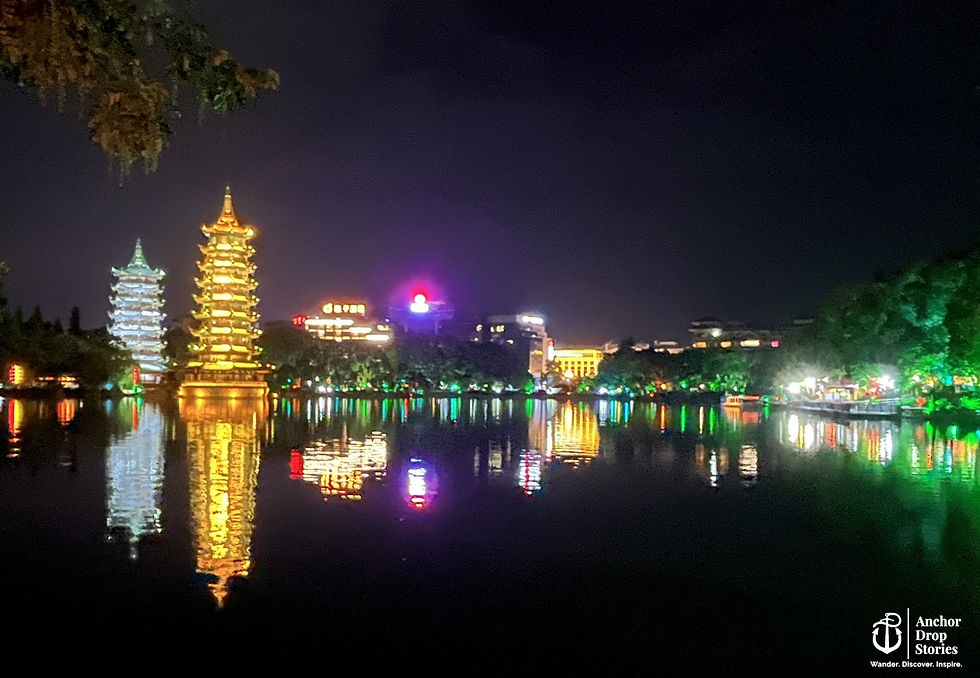
Though evening was already settling in, we still had time for a stroll along the riverside path, a wander through the park by Shanhu Lake, and a first look at Guilin’s lively main pedestrian street.

This was the place to be for street food and restaurants, and our next mission was to track down Guilin’s local speciality, beer fish. It required a bit of perseverance though. The Dianping food recommendation app pointed us to a promising spot, but none of the navigation apps could actually get us there, so after some zigzagging and dead ends, we finally arrived.
From the online description, I had pictured something more like a grilled main course, but what arrived was closer to a soup. Apparently, the fish is simmered in beer, though I couldn’t quite verify that. That said, once the pot was placed on the table’s heater, our waiter ceremoniously poured in half a can of beer, so it definitely lived up to its name. With fresh vegetables, a mild kick of spice, and tender fish, the whole thing was quite delicious.
Speaking of fresh, the fish was very much alive when we first met it. They chose it from one of the restaurant’s tanks, based on how many people were dining, and they weighed it right there. Impressively, they nailed the weight estimate. Kind of… tank to table.
Now, that was a success! The chicken dish, on the other hand, proved far less tourist friendly. For starters, I hadn’t realised it wasn’t just chicken, it was chicken and snails. Mostly snails. Cue the “Oh no!” look on our faces. Thankfully, the staff graciously offered to make a special version using only chicken. It took a little longer to prepare, and while it looked great… there was just no way we could eat it.
This one’s on me. As a long-time China resident, I should have connected the dots. Here, when chicken (or any bird, really) is served, it looks like it’s been run over. It’s chopped in all directions into bite-sized pieces, bones and all, resulting in a chaotic mix of meat and bone shrapnel. The locals handle it effortlessly; we, however, do not.
Luckily, the beer fish saved the night. Generous in portion, light on bones (ironically), and flavourful enough to feed all three of us. We topped off the meal with a bit of street food and called it a night, quite satisfied, and … with a new dinner story for the books.
On our way back, we passed again through the same park by the lake. Colourfully lit, with fewer people around, it was very peaceful.
When people say, “you must see Guilin,” they usually mean you must take the Li River cruise from Guilin to Yangshuo. So, that’s exactly what we did the following day. After breakfast, we hopped into the car arranged by our tour agency and drove about 30 km to the pier. We only took a daypack with us, while our luggage, left in the capable hands of the same driver, made its way to our hotel in Yangshuo. Another great perk of going with a private tour.
It’s the scenery along the river that puts this region on the map, literally. The karst mountains are so iconic that one of the river’s scenic spots is printed on the back of the 20¥ note. It’s now something of a tourist tradition to hold the banknote up and snap a photo with the real-life version in the background. I didn’t join that club, so no matching photo here, but you can … picture it.
The cruise took us on a 63 km journey deep into one of China’s most unique landscapes. On both sides of the river, lush, cone-shaped formations rose into the horizon, like a colossal forest sculpted from green stone. At first glance, they reminded me of Zhangjiajie’s famous pillars, but these were softer, gentler, more fluid in form. Here, it was all about water and limestone, the delicate artisans of karst topography. And, as it often goes with nature’s finest work, no two views were alike. For nearly four hours, we watched this living landscape shift and unfold, and it didn’t feel boring for a moment.
It was a cloudy, slightly rainy day, so we didn’t get to see the Li River in its postcard-perfect light. Still, we were grateful the forecasted downpour didn’t arrive. That meant we could spend most of our time up on the top deck, breeze in our faces, soaking up the serenity of yet another natural marvel.
We arrived in Yangshuo around noon, where our driver was already waiting. From there, we headed to our final accommodation, a lodge tucked away in a more remote corner of the town.
After checking in, we set off for a stroll around the neighbourhood and stopped at a surprisingly chic café nearby.

The café also doubled as the gatekeeper for a short scenic hike, access granted with the purchase of a drink. Ever the efficient team, two of us heroically ‘sacrificed’ ourselves by taking on some refreshments, while the third took on the climb. I was told the view from the top was lovely.
Later, we took a DiDi to West Street, the pedestrian hub of Yangshuo, packed with shops, street vendors, and restaurants, some with surprisingly lively entertainment for such a small town.
We wandered around checking out local crafts, dried fruits, and fresh fruit stalls. Lychees were in season, and we also found yumberries, apple bananas, dragon fruits, mangosteens, and some late-season loquats. I already knew most of them, but my friends were eager to taste everything. Watching them enjoy it all was a joy in itself.
I was, again, determined to try the local speciality: Yanghsuo noodles, whose official name is actually Guilin rice noodles (don’t ask me why). It took, again, some walking and getting lost following the navigation apps, but we finally found the street where noodle dishes felt at home. We picked a place that looked the most promising from a quality and cleanness point of view, and settled in.
The meal, in a typical traditional Chinese style, was simple: noodles (lots of them) in a rich broth (your choice of pork, chicken or seafood), some greens, and a tray of toppings (peanuts, scallions, chillies). Dumplings were also an option, or you could mix the two. The secret? Fresh noodles and broth, assembled on the spot. I was full halfway through but finished every last spoonful anyway.
Happy with our new culinary conquest, we walked back to West Street to help digestion, picking up a few fresh fruits on the way.
We started our second day in Yangshuo with a visit to the Longmen Water Cave, about an hour drive from our lodge. This impressive cave gave us a view from the inside out of a karst structure. It was well set up for visitors with safe walkways, clear signage, and a steady stream of quirky comparisons: rock formations dubbed “giant mushroom”, “eagle’s head”, “rice fields” or even “Buddha temple”. While we admired the creativity, we would have preferred less theatrical lighting, fewer neon colours would have let the cave’s natural beauty shine through. Still, a unique and memorable experience.
Although there were other several outdoor attractions around Yangshuo, they were a bit too far out for our limited time. So, in the afternoon, (the same) two of us opted for a massage while the third went for a swim (we got to be consistent, don’t we?)
In the evening, we returned to the city centre. Pleased with the previous night’s finding and not in the mood for a new food quest, we went back to the same place to try some new broth–noodle–dumpling combos. Afterwards, we wandered down West Street one last time, soaking in the crowds, lights, and colourful shops.
This was the last evening of our weeklong immersion into China’s landscape. The next day we were going to head back to Guilin by car and then fly home to Shanghai.
Visiting these places had been on my list for a while, and getting to tick them off with close friends made it all the more special. It’s one of those trips that stays with you, not just for the sights, but also for the shared laughs and the joy of adventuring together into unknown.
If you’re coming to China, I wholeheartedly recommend carving out time for at least part of this journey. Yes, experiencing outdoors here can be quite different. National parks are typically well-developed and can feel a bit too “packaged”. On the other hand, without this infrastructure, you would need some serious climbing gear and skills to get anywhere near the views. Myself, I got to appreciate the remarkable effort that has gone into making these landscapes accessible. If you can, aim for spring or autumn, for milder temperatures, fewer crowds, and landscapes at their best. And, try to avoid national holidays, unless you enjoy shuffling through scenic spots with several thousands new friends.
So, if you're even a little curious, go on, start planning your own adventure. China’s great outdoors are waiting!


Thanks for the wonderful time we spent together, it was a breathtaking and heartwarming experience!
Another awesome post. Too bad I could not go on the trip.😒
Keep doing what are you doing ❤️, sharing the experience and pictures that otherwise I might not be able to see it. Love it!
Wow what an update! I have seen pictures of the Stairways to heaven and would love to go there. And those colourful caves! I would be a bit worried about food, but the Smoked bamboo chicken and rice would be great.
And the way you 'sacrificed' yourself to get coffee. I always knew you were a selfless soul, but didn't know to that extent!
Thank you for another great update, Cristina. Such smooth writing and to reveal such a different view of life. Yes, one day would love to see China's outdoors, but for the moment I will have to accept this.